Showing posts with label all ages. Show all posts

Thursday, April 7, 2016

HOMESCHOOL PROJECT: Tea Blending Online

Good day, everyone! Today is actually a very windy and cloudy day, here in Tucson. A perfect day for tea! If you are not a tea drinker, hold tight... you may be one after this post. 

By no means am I a tea connoisseur, or expert, or anything. I am a casual drinker. I do believe in the benefits, certainly. I've always liked the taste, but only really actively got into loose leaf instead of tea bags about a year or so ago. Honestly, I would not have gotten into loose leaf if it hadn't been for a really neat brand I found, Adagio. 

Adagio is mainly a website. I believe they do have a store location, or two, but they are not a chain like Teavana. I don't think they even sell blends in other stores. Instead, you will probably have to order online... but, that is where the fun is. Adagio has a really cool feature that allows you to create your own custom blends, and they give you a pretty big variety of options to mix together. You can also buy the blends others have created. I have used this option over and over again, and other tea fans have actually quite liked my creations! If I, someone who doesn't know jack about tea blending can make yummies, anyone can, including you and your kids! I will post some screen shots of the creation process to guide you through, and of course, end with a summary of how this can be made into a great educational experience, along with some extra project ideas.

If you want to save your tea blends, you will have to create an adagio.com account, but they have you do that after you create a tea blend, so don't worry about that just yet. I already have an account, but I will create a new one to show the first steps. The reason for this is because the more blends you make, the more options you get, and I will demonstrate that as we go along.

Step 1: 
First, simply go to adagio.com. On the top-ish of the screen, click "blends," then "create a blend."

Step 2:
If you scroll down just a tad, there is a basic tutorial video, and you can watch that if you want, but it really is not that informative. Scroll down and you will see the first options, which is where you mix up to three different premade tea blends and flavors. Your options are a wide variety of teas, including different flavors or pu erh, green, white, oolong, Earl Grey, herbals, and more. They are all natural, even the flavored ones. There are even decaff options.

 
 When you select which teas to blend, you also have to choose the percentage of each blend. For instance, 30% white peach, 40% white chai, and 30% wild strawberry. The percentages are all in tens, and, obviously, you cannot make it add up to above or below 100%. Each flavor gives you a description of the taste and ingredients when you click it.


Now, here is something I noticed. When you are brand spanking new to the site, you do not have the option to add in inclusions, which are just extra little scoops of things like different flowers, fruits, and even candies. After you create a blend, you get the option to add in inclusions. Over time, as you create more blends, you are able to add in two, and eventually three. I am up to three inclusions per blend now. Now, of course, it may sound disappointing that you cannot immediately add these in, but not all is lost. We will get to that in a bit here. Lets go to step 3 for now.

Step 3:
Now that you have your blend chosen, you may now name and describe your tea. You can also give a little background on the inspiration for your special-TEA. Special-teeeaaa. See what I did?
Sorry.

Anyway, here is what that section looks like.
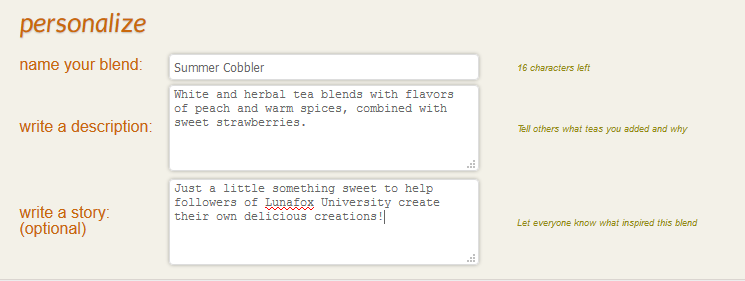
 Pretty neat, right? It's getting personal now.

Step 4:
The final step to creating the blend is the artwork. Adagio does ask that you do not use images created by other artists, as that is a risk of copyright infringement. However, you are free to upload your own photos and designs. You can also use one of the premade designs. Remember that custom designs have to be rectangular, or the designs will be squished to fit the format.


Step 5:
Now is wen you can create an account. You can set this particular tea blend to be private or public. The benefits to public blends are that others can purchase them. You do not get money for this, but you do get frequent user "cups," which can be used for credit to get more tea. 100 points is $10 in free tea! Points are earned by purchasing, reviewing, and "selling."You can also add tags that describe your tea to help others find them in their searches. When you are finished, clock "create blend."


Step 6:
Congrats!! You created your first tea blend! Doesn't it look pretty?

As you can see, you can like your blend on Facebook, pin it on Pinterest, or even Tweet it. Nothing wrong with sharing your creations!

Now, as for the prices, they may look hefty. To be honest, the sample prices are, but the pouches are actually a really good value. You get a lot more than it seems, and Adagio is cheaper than most loose leaf tea blends out there without sacrificing taste or quality. A full pouch, drinking once a day, can easily last you a couple months. Mine last me about a month if I drink every single day, but I also brew mine extra strong. 

Well, now that you basically know how to make your own blends, lets discuss how this can be used to educate your kids, shall we?

How can Adagio be used to teach kids?

1) Ratios and math. Young kids can benefit from using the percentage feature, as it helps them learn how to add tens to equal one whole, or 100%.
2) Advertising and marketing. What key words would you use to attract people to your blend? What sort of image portrays the flavors, colors, or ingredients used? Do you have a photo that works with the tea? Can you create an image? What age range do you think would like your tea blend the most? Does using other means of social media help attract customers?
3) Experimentation. How did your tea taste, if you ordered it? Is there anything you would change next time? How did it smell?
4) Health benefits. Teas have a huge range of health benefits, and different types all have different things that can aid your health. Some are full of antioxidants, and they all have different levels of caffeine. Look up the differences between loose leaf and tea bag. Fruits and herbs vary in health benefits as well. Even honey used to sweeten tea has healing properties. Research them together.
5) Gardening. How is tea grown? What is the difference between white, black, and green tea? What about oolong and rooibos? What sort of plants are used? Can you grow herbs for teas at home? What kind of bugs pollinate the plants used to teas?
6) Geography. Where does tea come from? What herbs and fruits grow best in different countries and climates?
7) History and social studies. Adagio even gives brief lessons on the origins, and even the growers, of their ingredients. History has a very huge history, and has been used for many things all around the world. Read up on how teas are used in different areas of the world.

What projects and lessons can be used in coordination with Adagio?

1) Grow your own tea ingredients. This is where that part about lacking the inclusions option comes in. If there is something you want to add to your tea, such as bits of fruit, spices, flowers, or even sprinkles and candy pieces (chocolate bits and candy cane can actually be quite yummy in tea!), learn how to grow them together, and start your own tea garden. If you don't want to wait a few years for a tree (in case you are thinking something like orange zest), then learn how to purchase the ingredient needed and properly dehydrate it for tea usage. That is a homestead and cooking skill that can be used for their whole lives!
2) Make it a sweet, artsy gift. Kids of all ages can have fun designing baggies, cards, or even making treats to go with their tea blends, and give them to friends and family. You can even use a tad bit of the tea blend in things like soaps, bath bombs, and lotion bars. 
3) Cook with tea. Yes, you can cook with tea! I have made my own recipes for green tea cake and black tea cake (which actually became a surprising family favorite). The trick is to boil about four tablespoons in the milk you use for your recipe, and leave the tea in the milk to bake in the cake. Experiment with different flavors of glaze, or add in extra coordinating fruits, spices, and nuts. You will have a truly unique dessert or breakfast cake.
4) Encourage your child to practice their marketing and advertisement skills. For young kids, allow them to design the label for the tea, and also an "poster." They can use paint, card stock, paper, stickers, whatever is on hand to design a poster used to grab a customer's attention. Have them draw pictures and use colors to represent the ingredients, or the actual product, and learn to use key words. Maybe, even have them act out a commercial. For older kids, they can design from scratch, or even use real photos they took (if they are into photography) and photo editing software such as PhotoShop, PhotoFiltre, and Gimp. Allow them to research the age range and gender that will be more likely to appreciate their tea blend. Teach them to use social media to spread the word on their new blend. Adagio also has a feature for leaving video reviews. If your child is curious about video reviews and commercials, allow them to work with that feature and create a well-made review. Advertising and marketing is a highly sought-after skill in any business, as it is what attracts customers. Pay attention to font style, colors, images, and descriptions. You can even suggest they research the cost of ingredients and discover how much ingredients from the source would cost so they may create an imaginary price for the blend.
5) Research the history of the ingredients. Where was white tea first used? Why is green tea so commonly used in Asian culture? How did Earl Grey tea get its name? Tea is full of rich histories. Research which cultures use and grow the types they used in their blends, how different cultures drink their teas, and how tea is used in everyday life and celebrations. You can also turn it into an English lesson and have them write a research paper on it.
6) Create specific teas meant to do specific tasks. For instance, if you are looking for a tea that is meant to calm the body before bed, research which teas have low caffeine and which herbs have calming effects. For teas that heal colds, look for ingredients that have high antioxidants and vitamin C. Teas can be used for nausea, headaches, illness, relaxation, and rejuvenation, depending on what is used. Remember that this includes tea leaves, fruits, herbs, and spices. If there is a pregnant woman in the family (or a friend), consider looking into what teas and herbs are safe to use on pregnant women, and what the benefits are. Be careful, though, as many doctors and midwives warn about using certain herbs. For instance, raspberry leaf is great for the third trimester, but heavily not recommended before that. Chamomile is also considered not safe during pregnancy. Young adults and teens can benefit from learning which herbs are safe and which aren't, for whenever they decide to start a family.
7) Research local tea growers. What local brands are there? What sort of unique ingredients are native to your home? What ingredients grow best in your climate? How much do they make in profit? Perhaps set up an interview with a local tea grower, and sample some of their product!


As you can see, something so simple can really be highly beneficial. I have been using the site for at least a year, and it only just hit me today that this can be a very educational tool for any age. Obviously, purchasing tea all the time can add up, especially is you are using loose leaf, so you may want to only do this every now and then. An alternate option is to buy some mixed sample boxes of tea bags from any grocery store, cut the bags open, and blend together, but honestly, you will not have the same quality. Tea bags also have to be heavily sweetened to even be palatable (to me, anyway) while loose leaf usually doesn't, since it contains whole fruits and higher quality ingredients. That's just my two cents, though.

So, relax, and have fun <3
What sort of teas do you like?
 

Wednesday, April 6, 2016

FAQ: Common Myths of Homeschooling (and Brutally Honest Answers)

We've all heard them... the annoying questions and comments about homeschooling. Questions like, "How will your kids get the socialization they need to become properly functioning adults?" and, "What makes you think you are qualified to teach?" Comments like, "No one hires homeschooled graduates, employers don't take them seriously!" and even, "Isn't it illegal to keep your kids home all the time?" I've been told, "You have no right to homeschool them. You owe it to your kids to let them decide where they want to go to school." The older generations seem to have some of the worse comments, in my experience. "Kids need to experience drugs and bullies to become stronger adults," (WHAT!?) and, "Keeping your kids home to learn is child abuse," are all things I have seen, heard, and been told. I am going to touch up on some of the most common misconceptions regarding homeschooling parents and kids, because, as you can see, some of the things (pretty much all of the things) people who disagree with the idea of teaching from home say are just plain whack.

Now, keep in mind, I have a pretty big history of switching schools, and school types. Just to give you an idea...

Preschool to third grade: Homechool/charter school, classes three times a week for a few hours.
Fourth grade: All home school.
Fifth grade through sixth grade: Standard public school.
Seventh and eight grade (middle school): Full time charter school/college prep school.
Freshman year: Standard public high school.
Sophomore: Two different standard public high schools, then independent study/charter school where I took classes only a couple days a week for a few hours. That is where I graduated from.

Why so many changes in schooling? Oh, goodness... divorce, moving over and over, student bullies, teacher bullies... It was so bad, that I started going to the independent study program because I was coming home in tears every single day, begging to not have to go back. I went from Honor Roll student to miserable blob, absolutely despising the public school system, fearing her life because of death threats from other students, and because teachers wouldn't take those threats seriously at all. Never mind the on campus rape, students held at gunpoint, teacher taking inappropriate photos of female students, all that year... and this was at once of the highest rated high schools in California. When I started independent study, I was so much happier. Teachers were less overwhelmed, and happier as well! They were all just wonderful. I did all my work on my own at home, except for Spanish and Biology, which I had classes for twice a week for about an hour and a half each. I did have to see a teacher to look over my other main courses once a week for an hour. That was it. I also passed my California High School Exam with some of the highest scores the school had ever seen. I THRIVED. Now, with that said, there were definitely ways the school could have improved. The courses they had available, especially electives, were very minimal. They did work very hard at encouraging the students, and finding their unique skills, as well as forming a bond with the students and working with them to find a curriculum that suited them better. It's certainly a better option than basic public schooling, but I do not feel it's the best option. We all want the best, right?

As I have mentioned, though, many do not feel homeschool is the best. Usually, when you ask them why, it is because of all the negative myths they have heard from other skeptical parents, or even on the news.

I'm gonna sound a little less serious than I usually do here, because people like that make me sassy, and I am going to be totally real with you here.

Anyway, lets look at one of the first things people question when they hear those oh-so-dreadful words, "I am going to homeschool the kids."

1) Kids will not get the socialization they need. This comment is one of the most common ones you will hear, or already do hear. It's also one of the most incorrect ones. There are hundreds of ways to get your kids socialized. Sign them up for a class like martial arts, music, dance, anything. Get them in a sports team. Look for volunteer opportunities for them to do. Set up play dates. Let them make friends at the park. There are usually groups on Facebook for local homeschooling parents, and these groups often organize social functions together. If you can't find one, start one! It's okay if it starts off small. Your kids will benefit more from having a small group of real friends over 35 acquaintances. It also allows the opportunity to bounce off ideas with other parents, find new materials, make friends with the parents, and the kids can greatly benefit from learning how to socialize with others from a wide variety of ages as opposed to strictly kids their age like standard classes do. And, lets be real... are kids who are abusive or socially awkward any better examples of socialized kids? Yes, many bullies have emotional issues going on, and awkward children can be awkward for a variety of reasons, but public school won't always fix that. If these kids are still mean or shy in high school, then obviously, public school didn't fix it. That isn't a convincing argument for public socialization. If your child is well behaved, then you may not want your kids around other misbehaving kids all the time. Honestly, it's stressful for many kids to be part of.

2) You will not have the patience to homeschool them.  This one throws me off a bit. I know of some parents who have been told that, but I also know of a lot of parents who say that about themselves. Now, I am going to rebut that with a question... Patience for what?

Here is the thing about that. If you see homeschooling as strictly giving worksheets and textbooks, basically what public schools do, and you don't see your child being able to focus on those, and you will drive yourself crazy trying to get them to do their homework... then yeah, no patience for that. We are not meant to conform. Conforming makes things difficult. That is not what homeschooling is about. It's not supposed to be like public school. It's not supposed to be about forcing your kids to do homework, obeying teachers, conforming to strict schedules... Especially if they are young kids. Kids pay attention better if they are having fun and are frequently allowed to play, and be creative. What is there to be "patient" about with your kids playing and learning? If it's because they are loud and obnoxious, well, guess what? Your teacher will have even less patience. If you don't have patience for teaching your own child, why do you think someone with a group of 30+ they have never met before will have more? Do you have patience for frequent calls from their teachers or principle because they didn't follow their rules, or were late, or skipped, or wore shorts a tad too small, or weren't paying attention? Do you have the patience to try and hunt down the issues based on what third parties are telling you? Do you have the patience to deal with a child who is failing school because they feel unmotivated? Do you have the patience to deal with making sure a bully actually gets punished and made to stop bullying your kid? Do you have patience for arbitrary rules?

Please, remember... many teachers go into the job with the purest intentions of shaping the kids for the future. However, they get a lot of the students with parents who feel like they do not have the patience to teach, and they get 30 of them, at least, at once. These teachers get overwhelmed, and when they do, so do the kids, and when they both get overwhelmed, so do you, because you have to deal with the aftermath. You are the parent. You are the one who knows your kids. If you are using entertaining and interactive methods that you and your child are enjoying together, then you will not have to find a ton of patience. That is one of the biggest benefits to homeschool.

3) You cannot afford to homeschool. Now, I understand, there are exceptions to this. Not everyone has a decent source of income because times are tough. Single parents do not always have strong family support to watch kids while they work, and daycare is freaking expensive. However, there are alternatives to look into and consider. One of the benefits to homeschooling is that it all works on your schedule. You do not have to be an 8-3 schooling family. You don't have to have a particular schedule at all! If you are a married homeschooling couple, if possible (and if needed), one of you work a night shift job. If you feel like that may be too overwhelming, there is no shame in breaking the educational times into different times so that one parent can work while the other is with the kids, then trade off. There may be less "family time," but having your kids in school plus doing homework from 8-5 doesn't exactly leave room for family time, either. As far as single parents go, I cannot give 100% surefire advice on that. My mother, with four kids, cleaned houses and sold on eBay for a living, using by grandmother as a babysitter, when needed. Some parents are taking to sewing, baking, and catering as a profession. There are options, but since every situation is drastically different, it's up to you to do the math and see what works. I have met mothers who send their kids with another homeschooling parent and work out a payment deal with them. It's usually possible to find a way to homeschool on low income, you just have to figure out what you are willing to do and know what is possible (and again, every situation is different, so if you really do not feel it is possible, that's okay. Don't risk losing your house or something).

 4) They need to be on a specific set schedule because the real world has schedules. *ahem* WRONGWRONGWRONGWRONGWRONGWRONGWRONGWRONGWRONG. Public school and full time jobs have set schedules. Your kid isn't in public school, so there goes half your problem. Your kid probably won't even have a full time job until they're well into college age, so there goes the other half. Colleges don't even have ones that strict as many allow you to choose what time of day you study, or even just let you view lessons online when you can. What schedules are we talking about? When your teen or young adult gets his or her first job, it's most likely going to be part time, and finding a part time job with a solid schedule is an uncommon blessing. They are usually, "We'll fit you in when needed," or, "It's a slow day, you can go home," OR, "We're understaffed and really busy, can you be here in twenty minutes?" Heck, your work schedule can change! Do not get your kids used to a particular schedule, unless they honestly do thrive on one. Some kids, especially ones with ADHD, Asperger's, etc do function better on a schedule, which is fine! However, what often happens is that if something unexpected happens, they can get overwhelmed. That's something that is quite based on the individual, though, which is great about homeschooling! Some kids need a "10:00 is when I study history, 11:00 is science, etc" type thing because it helps them stay on track and not forget anything. Others, like myself, do best with, "Well, these are my tasks and goals, I feel really curious about this particular thing right now, so I am going to focus on that because I am motivated and can retain the information better." The only real schedule the world has is night and day. The weather has no true schedule it follows, nor traffic, nor illness... anything can happen at any time, and it helps to be prepared to deal with random things being thrown at you so you know how to work around them. The methods are all up to you, based on how your child learns and functions, which can only be done by homeschooling.

5) Homeschooling is illegal. Yeah, no. Granted, every state has different laws, and some are more strict than others, but illegal? No. Maybe if you live in Germany, but not if you live in the U.S. However, as mentioned, every state is different with their laws. Some states do (unfortunately) make you follow a very strict curriculum and gain approval by the state (blugh), but others, like where I live, have very few regulations (yay, Arizona!). I most certainly do not know all the individual state laws, so you will have to look them up. I know here, you have to fill out a very basic form that basically just says, "Yeah, I am homeschooling" when they hit age six. As long as you teach them something that counts as math, science, social studies, history, and English arts, you're good. There are no particular guidelines as to what defines those since there are thousands of things that can be defined as any number of those subjects. When your child graduates, you can have an official, certified diploma printed out, either a normal sized one for $30, or a "pocket" one for your wallet (great for showing at job interviews) for $10. It is that easy. That's Arizona law, though! Be sure to look up by county, since they can vary.

6) It is child abuse to keep your kid home all day. Sorry, I think it's worse to send my kids somewhere where they are subjected to bullies, made to feel stupid because they failed a test that really will not matter in the future, or feel like a loser because cliques don't want to talk to them because they are different. I think it's worse to force my kid to study what the world wants them to study instead of what makes them happy and confident. It is worse to make your kid feel like their struggles are always their fault and they deserve it instead of realizing that they simply have different needs. 

7) Your child has every right to choose where they want to be schooled.  Look, I get it. You want your kids to make decisions for themselves. Learn from consequence, be more confident, etc. I see where you are coming from, but here is the thing... kids are still kids. Yes, their voice matters. Yes, they should be encouraged to make decisions... but here is the thing. They should be encouraged to make educated decisions. A four-year-old is not going to have enough understanding of life to make a truly informed decision on schooling options. If I let my daughter choose, she would eat nothing but cookies all day. She is just about four. It does not matter how much I tell her, "That is bad for you, you will get sick, and you need to brush your teeth," because she does not understand the trials of obesity and tooth decay, she's a child. I have to put my foot down. I will continue to have to put my foot down with different things as they get older. That is okay to do. I repeat, that is okay to do. You are their parent. Even older kids will have difficulties because they often do not know what they even want to focus on, especially in places that teach only a handful of subjects. It is literally your job to protect them because they are too young and inexperienced to fully understand why you decide to homeschool them. That is why you hold their hand when you cross the street, whether they like it or not. That is why you give them medicine when they need it, if they like the taste or not. You may think those are extreme comparisons, but they aren't, because we are talking about how your child will be able to handle adulthood. That is a huge thing. That is the most important thing they need to learn. I cannot stress that enough. Do I think you should decide everything they learn? No. That is why I support homeschooling and unschooling, because they can choose the subjects themselves. I liked writing educational essays. I did not like writing poetry. I still hate poetry. I am almost 25 and still do not use poetry. Why was I forced to learn poetry for so many years!? My interests were ancient history, cryptozoology, astronomy, things like that. X-Files stuff. Those things have actually been my interest since about age six. I sometimes slacked in school because I was too busy reading about UFOs and genetic engineering (I kid you not) instead of studying about Shakespeare. Those things made me happy. I don't friggin use Shakespeare in my life. I felt dumb for failing tests on Hamlet, and made to feel dumb by teachers and finals, yet I knew more about the M-Theory than probably any other student (or even many teachers) in school, but that didn't matter. Screw me for not having an interest in an overly dramatic teen drama from hundreds of years ago. 

Anyway, introduce your kids to different things, but do not take away their interests they naturally have. Encourage those. Heck, if it's that important to you that they learn all about something in particular, encourage them to look up any connections between their interest and the lesson you want. Columbus got way more interesting after I found out he reported a UFO sighting, I can tell you that much. It also helped me learn that public school is teaching very incorrect things about him. You can still allow your kids to make decisions on what they want to learn. That is still giving them power. After all, home resources have more subjects it can teach you than public school does. Another thing... your child will not have the power to say no in public school. They will have to learn, say, read, eat, and even wear what they are told to wear. They will not have power of choice at public school like they will at home, as long as you allow it. Public school teaches to follow authority (no matter what), schedules, and trends. That is not freedom of choice.

8) They will not be able to learn real political issues from home. Um, it's illegal in some areas for teachers to discuss political issues because it is too easy for them to slip political bias in their lessons. Allow your child to research issues from home, listen to the stories of different sides, and formulate conclusions. Do you really want a stranger giving an unsupervised political bias anyway?

9) They will not learn about other cultures and lifestyles at home. Considering that it's actually very frowned upon for students of various faiths to practice their faiths in school, I feel okay saying that school is not the way to learn about different cultures. Many kids are shamed for their beliefs. I was, and I know I am by far not the only one. Teachers shamed me hardcore for not making Christmas cards for teachers I never met. Text books often give drastic misrepresentations of religion, and can no way cover all sects and beliefs. Many want religion kept out of school anyway. There are many different resources for learning about various cultures. Cookbooks, movies, games, inventions, clothing, music, stories, festivals, museums, jewelry, friendship... these can all be used to teach different cultures. It's also way more fun to learn that way instead of reading poor summaries of a handful of lifestyles.

10) No one hires homeschool graduates. Very untrue. Homeschooled kids statistically graduate earlier and do better in college. They are actually quite sought after! They often have a stronger sense of responsibility and taking initiative since they are encouraged to self educate.
11) You are not qualified to homeschool. You know what teachers use? Curriculum given to them. Guidelines given to them. Answer sheets given to them. They do not come up with every single lesson plan from scratch, in most cases. Heck, it's against the law for them to do that, often times, because they have a strict set of lessons they have to give. Every state varies, but in general, teachers have support systems and are told what to teach. You can find support and answer sheets just as well as they can (and yes, I know many do come up with extra ways of teaching, but that is also something you can do!). There is a huge range of support out there, just like there is for teachers. And really, if you feel like the public school failed you, why have so much faith they will be better for your kids? Especially in a generation that people claim is far more spoiled and lazy than before? 

Trust me, I have so much more I can say on pretty much all these subjects, but that will be very lengthy. Over time, I will elaborate in detail more on the individual subjects in different posts. My goal is to help you understand that you can do this. It's not as bad as it sounds. 

What comments have you been told when you expressed your desire to homeschool? What was your answer?

Sunday, March 27, 2016

DIY PROJECT: Melt and Pour Goat Milk Soap

Hello, everyone! Turns out, today is Easter. My family does not really celebrate most holidays, so we didn't do any egg dipping, hunting, or anything bunny-related. We did, however, make some simple springy soaps today. 

Now, there is nothing super duper fancy or different about these soaps than what you may have done before. These are just simple melt and pour soaps. However, these are an excellent craft for kids of any age three and up to do! But, if doing this with little bitty ones, be sure they are able to understand to not touch any of the containers that hold the melted soap, because they are hot. I did this today with my two kids, ages 2 1/2 and almost 4. My 4-year-old daughter did a great job following directions and being sure not to touch anything I told her was hot. She knows hot = ouchie. My son, well... he was impatient. He loves to stir things and play with colors, so he was overly eager about using my food coloring. He also loves to mix things. It makes him feel like a big boy, so being told, "We need to stop mixing," just devastates him. It's awful to hear, I know. But, those are my kids. Every child is different. You have to make the call on if your kids can handle the project.

To make the soaps, we started with the absolute basics: Pour and melt soap base, peppermint essential oil, silicone molds, and food coloring. You can add extra things (I actually did mix in some cocoa powder into one of them), but for your first time, especially if you have really little ones or multiple kids, you might just want to start off simple.

This is the soap base I used, Goats milk Glycerin Soap Base- 2 Pound by Soap Expressions. 2 pounds for about $10, shipped with Prime. I used three out of eight rows (going horizontally) and we got five bars of soap. In total, depending on your mold size, this should make about 8-12 bars. That can change, too, depending on what sort of things you add in that can take more space, like coffee beans, flowers, or even plastic toys. 

Just cut them up into cubes in a microwave-safe bowl. It took about two minutes for them to get thoroughly melted, melted at one minute at a time. They do harden back up fairly quickly, but you can remelt them with no issue. 

Now, do take note, this stuff does have a funny smell. In my experience, though, pretty much all melt and pour soaps smell funny. Be sure to have some sort of essential oil to make these smell the way you want. We used NOW Foods Peppermint Oil (Liquid), 4 oz for these ones. It takes a few drops per bar, I'd say, but just add it in one or two drops at a time until is smells how you want it to smell. 

You can also add food coloring to this. I used a single drop of concentrated Ameri-Color food gels, found on Amazon. That blue swirl was later added by my daughter. You can use any food coloring. Don't use too much, or the lather will be too colorful and can tint your hands. 
My daughter decided to go with purple, and she chose a flower mold. You can make them solid colors, or you can make multiple small containers of different colors and swirl them, or layer them in the mold. Be sure to add your oils into the soaps BEFORE you swirl or layer, and before you put them in the mold. After that, you just wait and let them cool down. That's it. If you layer them, you will have to let each color cool down in the mold before adding the next layer on top, or they will mix together.

Now, I got my molds in various places. I actually have a pretty huge silicone mold collection. I love them. They are so versatile, easy to use, and come in almost any shape you can think of. The ones I used today were a sunflower one that my mother had bought for me from a garage sale, and a woodsy one from World Market. It's normally $6, but I purchased it for $3 during a sale. You can find these all over- Walmart, Amazon, Target, eBay, AliExpress... usually, they are very cheap. They can cost about $10 each on Amazon with Prime. I typically buy from China sellers on eBay, which brings them at only about $3 per mold, give or take. That does take longer to arrive, though.

Now, I know... It is a very simple task. Not much rocket science behind it. So, how does it benefit your child? Lets count the ways.
1) It allows experimentation with color. They get to see first hand how colors mix into new ones. 
2) It's a marketable skill. If they enjoy this, encourage it! Quality soaps can be sold online. As they grow older, they can learn more and more about which oils and add ins to use and what they do. Eventually, they can even learn how to make high-quality soaps from scratch. It's a product that can grow with them, so they can make money in the future as a side job or main source of income, if they choose.
3) It's a science lesson. Which soap base makes your skin feel softer- the plain glycerine, the goat milk base, or the honey base? What happens if you mix them? What do the different oils do for your skin? Why does the goat milk soften skin? What oils smell good when mixed together? These are all things you can research together, and experiment with. When they grow older (I would suggest at least age 12 because doing this from scratch can be dangerous, if you are not careful), you can all learn how to make these from different oils and lye. These will give you higher-quality soaps, but you do have to be extremely careful. Lye is in every soap out there except glycerine bases like this, but in its pure form, it can badly burn your skin. However, thousands of people do it all over the world just fine. You just need to take the proper precautions.
4) It's a great sensory and stimulation project. On top of the colors alone being fun to use (and of course, if you do not feel comfortable with food dyes, you can use natural ingredients and food colorings like beet powder), you can also add things nice to the touch. Coffee beans and oats are great for the skin as well as give texture to the soap. Just make sure they are small enough to go down the drain. Salt gives an exfoliating texture. Flower petals add a touch of natural color and are delicate on the skin.
5) You can make it a lesson in natural medicine. Have your kids smell the different oils and discuss how they make them feel. Which ones make them feel relaxed? Which ones make them feel rejuvenated? Which ones are healthiest for the skin? Let them pick out a scent, and research together and experiment with what else the oils can be used for. For instance, peppermint is also great for curing headaches and easing nausea, when sniffed. You can even use herbs and flower petals, as long as they are safe for the skin.
6) Show them how to make a home business with it. If this is something they enjoy, and keep asking over and over to do, show them how to sell some to earn money to buy more supplies. After all, the costs can get hefty. Research together what colors go with what smells- orange with orange, green with mint, yellow with lemon, etc. Also take time to associate shapes, colors, and ingredients with the seasons. Molds that make sunflower shapes would be great for spring or summer, and you can make them in citrus scents to match their yellow color. Learn about what soaps will appeal most to men, women, boys, and girls. Teach them to add and subtract supplies, profits, and if applicable, selling fees. It generally costs about a dollar per bar, on estimate, so figure out a profit margin you would like to help them make, and advertise away to friends and family, even neighbors. If you wish, you can even teach them about paying "employees." 
7) It encourages hygiene. Kids love using what they make themselves. They're going to love using their own soaps in the tub! Pair this with a lesson on germs and avoiding getting sick.
8) They make adorable gifts. You can make ones with more woodsy scents for Dad and Grandpa, pretty floral ones for Grandma, or fruity ones for friends- whatever they would like best! It's a gift that is completely custom made for them by the little loved ones in their life, and they can actually use them. They take thought, time, and love to make, which makes them even more special. I already have one grandma asking for some!
9) It's a great family bonding project. You all get to make something usable and enjoyable. They're pretty, functional, smell good... and hard to mess up. You may have a bit of dishes left over, but at least they are dirtied with soaps! 
10) It's great for all ages, boy and girl. Really, kids of all ages and genders can have fun with this. Just because it's a "spa item" doesn't mean it has to be all about pink, glitter and flowers, unless that's what your boys like. There are plenty of more "masculine" scents out there to use. Heck, if they are skeptical teen boys, encourage them to use scents that girls like on men, if that's what it takes. And come on... what girl would not swoon if a guy took time to make them pretty soaps? Buy an alphabet mold and help him make hand sized soaps that make a sweet message. Use your imagination!
10) It teaches patience. You do have to wait for them to cool down, after all! Good things come to those who wait- a lesson we all have to learn.
11) It's a confidence booster. Kids will be so proud of these! My son has been carrying his soaps for two hours now... sheesh.

Honestly, you can't really go wrong with this project. It's a lot more educational than people realize. 


Seriously, look how cute these are. Not bad for a couple kids under four.

Another neat thing, very little of the product goes to waste. It just peels right off the spatulas and bowls.
No joke, it just peeled right off. That made clean up so much easier. I just rolled it up into a ball, heated it for ten seconds, and smooshed it into a mold.

So, overall, this is a great thing to do with kids. You can even make a gift out of it and buy your kids extras like glitter, toys, and more to add in and have a big soap making day. Have fun!

In case you are wondering, here are links to what I used.